
Finding The Essence: Each Movement Has Key Points
When students ask how long I have been doing T’ai Chi Chih and I answer, “33 years,” some are perplexed that I could study and stay interested in such a simple practice for so long. I explain that in the beginning the practice is external, learning how to shift weight correctly, learning the shape of the hand/arm patterns and coordinating the two. We study how the principles apply to each movement. Then we move inward and begin to feel our way through the movements rather than think our way through. We explore, with feeling-awareness, how to move with the least amount of effort, how to ground more effectively, how to pare down excesses, understanding what is important and what is superficial.
In becoming a teacher trainer in 2002 I felt a great responsibility to pass on the form correctly. I would correct a teacher’s shape of the hands: “more curve, less curve, the hands pass here, the hand turns this way, the upper arm only comes forward to a certain point, the shape is a perfectly round circle.” And so on. Oh my, how tedious.
Several years ago we had a teacher conference focused on “The Essence of TCC.” It is only just now, in the past year or so, that I feel I am truly exploring the essence of the practice. In reading what Justin has written about each movement, listening to what he says about them as he teaches on his DVDs and watching how he moves, there are occasionally some discrepancies. So how does one decide what is “correct”?
When someone would ask Justin about the correct placement of the hands in a particular movement, occasionally his answer was “two inches here, two inches there.” In Spiritual Odyssey Justin wrote, “You cannot give the same teaching to two people. It must fit the Karma of each one and never be a teaching by rote. How do you know what teaching to give? You will be guided.”
My exploration of the practice lately has been to decide what are the key points of each movement, trying to pare down the information of each movement to a couple of “musts” that I feel really defines that movement, and the rest of the information, play with and find my own truth. I am referring to the arm/hand pattern when talking about the key points.
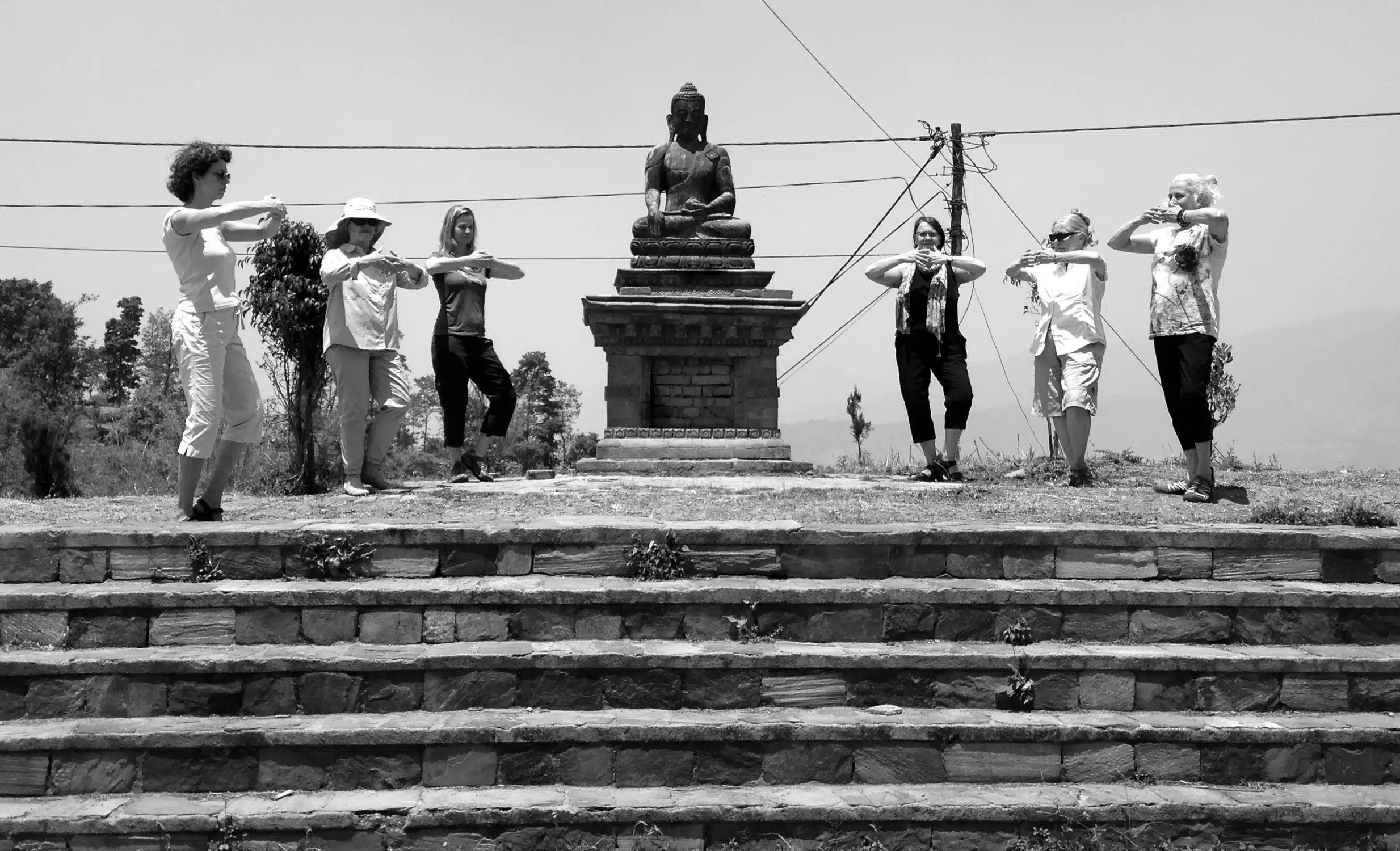
In Daughter in the Valley, given that we are doing the weight shift correctly and following the principles of softness, continuity, circularity, etc., what I feel is the number one key point of the movement is that the hands rise with the forward weight shift. The second key point is that the palms come close together at the lowest point of the circle and hold that palm-to-palm polarity all the way to the top. When the hands separate after arriving at the top is not important as long as the motion is integrated into the flow and not an independent hand movement.
I am working on moving away from trying to define and box in each aspect of a movement, and adhere to what I feel are the core important key points of a movement while allowing exploration of the rest within the framework of the principles we use in TCC. It can actually be a fun and enlightening exercise to try to define for yourself what you consider to be the two or three key points of each movement’s hand/arm pattern.
Justin gave us the outline or skeleton of the form, the shape of the form. It is for us to fill it in with our understanding and experience within the framework he gave us. I am not advocating changing the moves of TCC. I am encouraging each of us to explore and play with the form and feel for ourselves.
In Justin’s article, “All Things are as They Have Always Been,” found in Spiritual Odyssey, he is writing about meditation but I feel it also applies to the above.
“Those who do TCC regularly have not been taught how they should feel or what they should experience. Whatever happens is right and does not have to be adjusted to any doctrine or dogma. It is for this reason that I sometimes do not answer questions that would call for conceptual answers – they would spoil the experience.
Words have their place and are absolutely necessary for communication and the accumulation of knowledge, but they are not capable of taking the place of a valid experience. Words are, by their very nature, dualistic, and no realization of ‘Oneness’ (wholeness) can come from subject-object thinking. In short, do not be afraid to experience without labeling, or even remembering, the experience.”
Topics: