
How to Keep Them Coming Back
Especially after a first drop-in class. The musings below were inspired by Sandy’s January “Second Saturday” teachers’ practice — and reflecting on keeping students after a first drop-in class.
About half my teaching-time is spent working exclusively with veterans in some sort of chronic pain. And, frankly, teaching T’ai Chi Chih for the Federal T’ai Chi for Veterans program over the last 2-plus years has been both the most brain damaging and enlightening experience I’ve ever had. Most of the time the room is filled primarily with men, some of whom can’t stand up while others won’t sit down. For some students it’s their first day, while others have been coming for years. Some are Zooming and some are physically surrounding me. Sometimes I’m out in the middle of a field and have to use my phone as a hotspot, then the sun shifts onto the laptop screen making it invisible, or the power will fail. Creating a meaningful class for that wide an array of participants and situations is a challenge.
During Sandy’s class I found myself wondering what is it exactly that brings people back to a TCC class time after time? And it occurred to me: it’s the teacher.
But I’m not patting myself on the back for being the world’s greatest teacher.
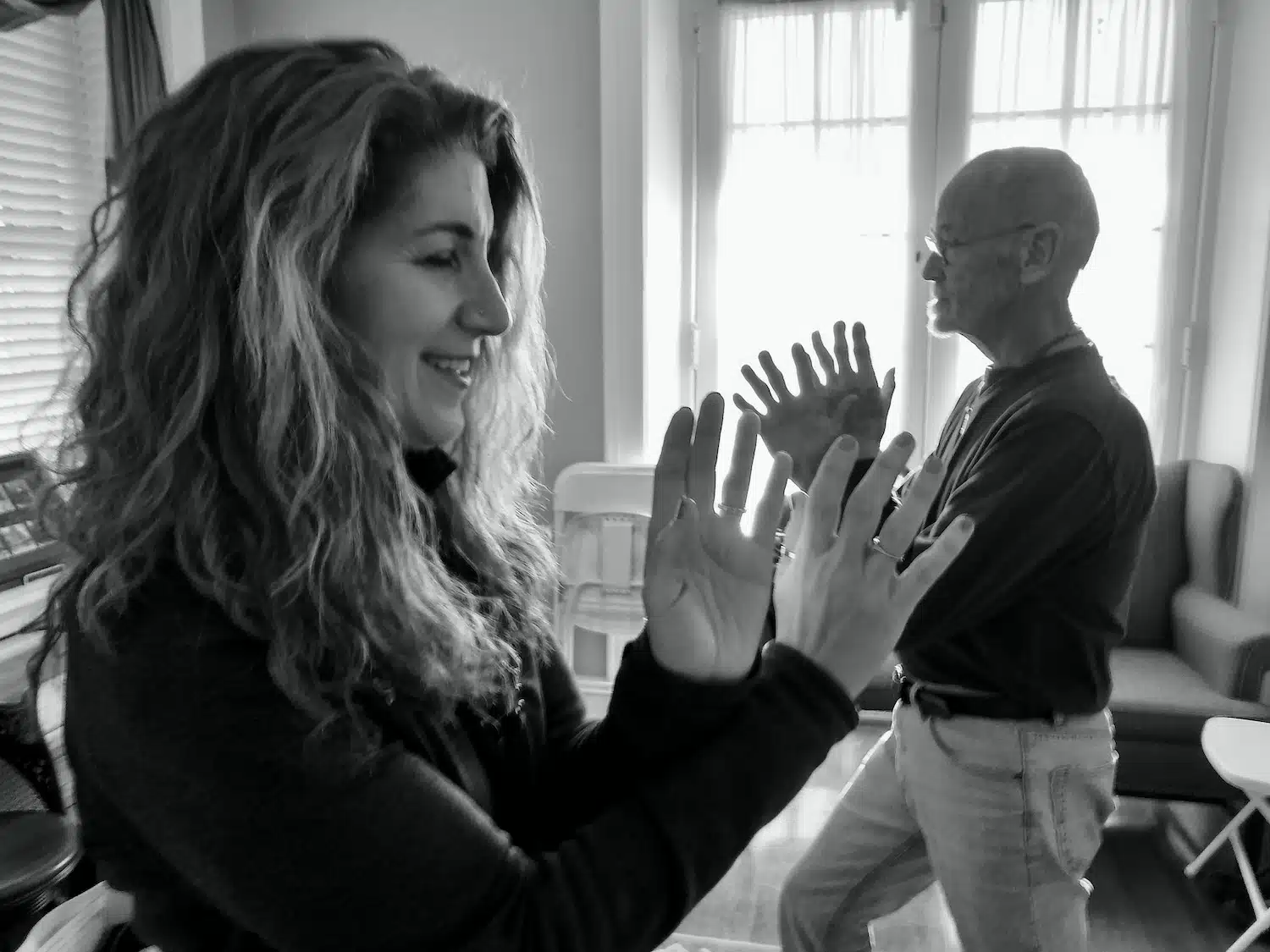
I’m talking about creating a fun (even playful) environment where almost nothing is wrong (for, as teacher Bill Moore often says, “There’s no such thing as bad TCC, only good and gooder.”) Moreover, I think it’s important to use very little language (at least in that first class or two). You’d be shocked at how beautifully people often move with little to no instruction. (Many have shared, especially during the last two years of Covid-19, how easily they learned TCC by practicing with April and me on our silent YouTube video. It’s so much easier to get out of your head when there are no words flowing into that crazy mental file cabinet.)
What often brings them back is: “There’s something about that teacher or class I want more of in my life.”
Most importantly, we must always remember that TCC is really an inner or healing art, rather than a martial art. Although the student at first typically bonds to their teacher and going to a TCC class with a wonderful teacher is indeed a wonderful experience, eventually there must come a time when TCC begins to teach TCC. The real trick to bringing them back is to simply allow the students to explore the Chi in ways that are (hopefully) completely unlike their “real” (hard, critical, painful) life — just long enough to realize that the real magic of what’s happening in TCC class is what’s happening inside. Once the student notices their internal experience in class is something they’ve never experienced before, they’re hooked on the practice itself.
Justin always said we should never doubt our own experience. So, let’s give the student a chance to experience for themselves — in a whole new way — by showing up as much like the Chi as possible: soft and smooth, open, and curious, fun, and easy-going. Let’s create a space where all are the same.
I often start folks seated, but not because some of my students can’t stand. I do it because I think it’s the easiest way for new students to tap into their tan t‘ien in the very first movement.
Topics: