
Continuity
Prompted by Justin’s DVD and 2007 notes to teachers, I looked again at softness and continuity, the essence of T’ai Chi Chih. Please take the following to heart as you read: Don’t believe anything I say. If some resonates, incorporate it, play with it. If not, ignore it. (And if you are tempted to stop reading now, jump to the last paragraph.)
When I say continuity what comes to mind is “it just keeps going,” but it’s hard to put into words. Words are like maps; they are not reality. If we are lucky, they help us understand what reality may be. If not, we wander.
For the time being please accept that continuity involves a recognized rhythm, a steady flow, and that perception of continuity lies in your level of observation and understanding. If I ask, “What is continuity?” you will likely use words to describe how you perceive continuity. Your perception is your reality, and it may only slightly overlap mine. Yet somehow, we communicate.
There are many layers to perception. If you are trying to describe one layer and I am looking at another, it’s easy to get confused. The meaning of continuity is like an onion with many layers.
For some, continuity means to smoothly run your finger around a circle without stopping. For me a symphony is continuity, going from beginning to end with four movements, each with notes and rests — and layers of continuity. Each note has a beginning and an end and leads to the next. If all I perceive is a note, then my sense of continuity is broken at the end of the first note.
If continuous means without stopping, that is how I perceive the flow of Chi. It is the never-ending river of existence that supports everything else.
Our neurons can only fire every so often before they have to rest to recharge. The brain then interprets all of these firings to allow us to perceive our universe as continuous from one moment to the next. In one understanding of reality, the universe is a disconnected set of activities our brain stiches together into a meaningful whole like a pointillist painting. From a distance we see what the artist wanted us to see, complete and whole.
The same can be said about the perception of smoothness. To bring it back to TCC, if Justin says TCC’s essence is continuity and smoothness, ask yourself what kind of continuity you are focusing on. Is it on the movement of a wrist? Is it on the individual movement from beginning to end? How does the continuity (or smoothness) of a wrist movement feed into the next layer of the whole movement? Or relate to the continuity of the arm or leg?
Is my focus perceiving the connectedness of one movement to the next like a pointillist Seurat creation? Where the whole TCC image doesn’t become clear until all of the dots are perceived as connected? Can I hold multiple levels of perception at the same time?
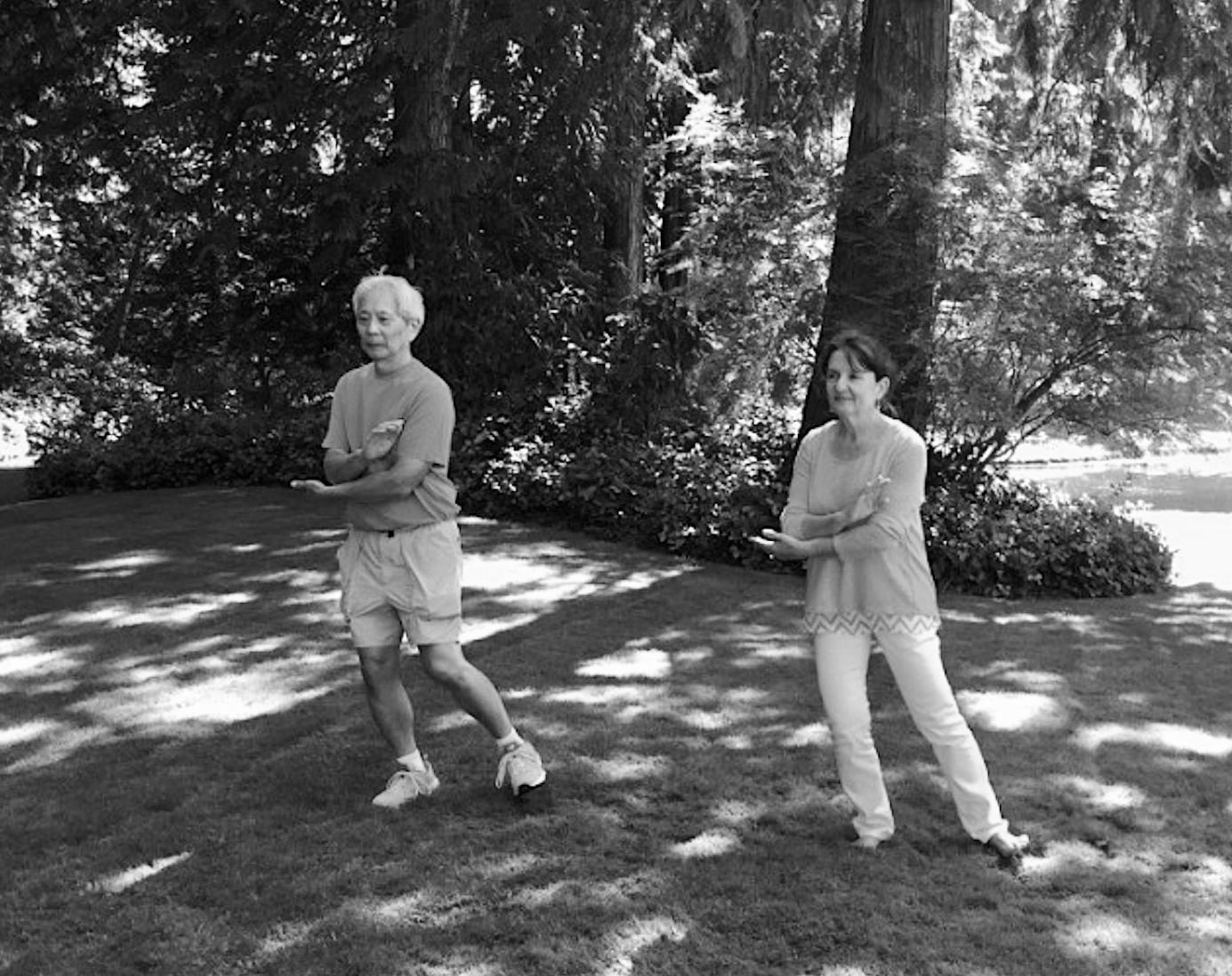
Am I perceiving the connectedness of all of my movements to my fellow students practicing next to me? And how that is connected to a larger flow of TCC with other practitioners worldwide? And so on.
As you practice, look at one layer, then another, and another. Then put it all down and let it flow. Yes, I indulged my love of mind and word play here; TCC is none of this. TCC is perceived in the doing, not in talking about it. And yet the talk is goes on at the same time.
Topics: