
Categories: Teacher Experiences & Reflections
Discovering Joy In A Nursing Home
By: Kent Jarratt
Asbury Park, New Jersey
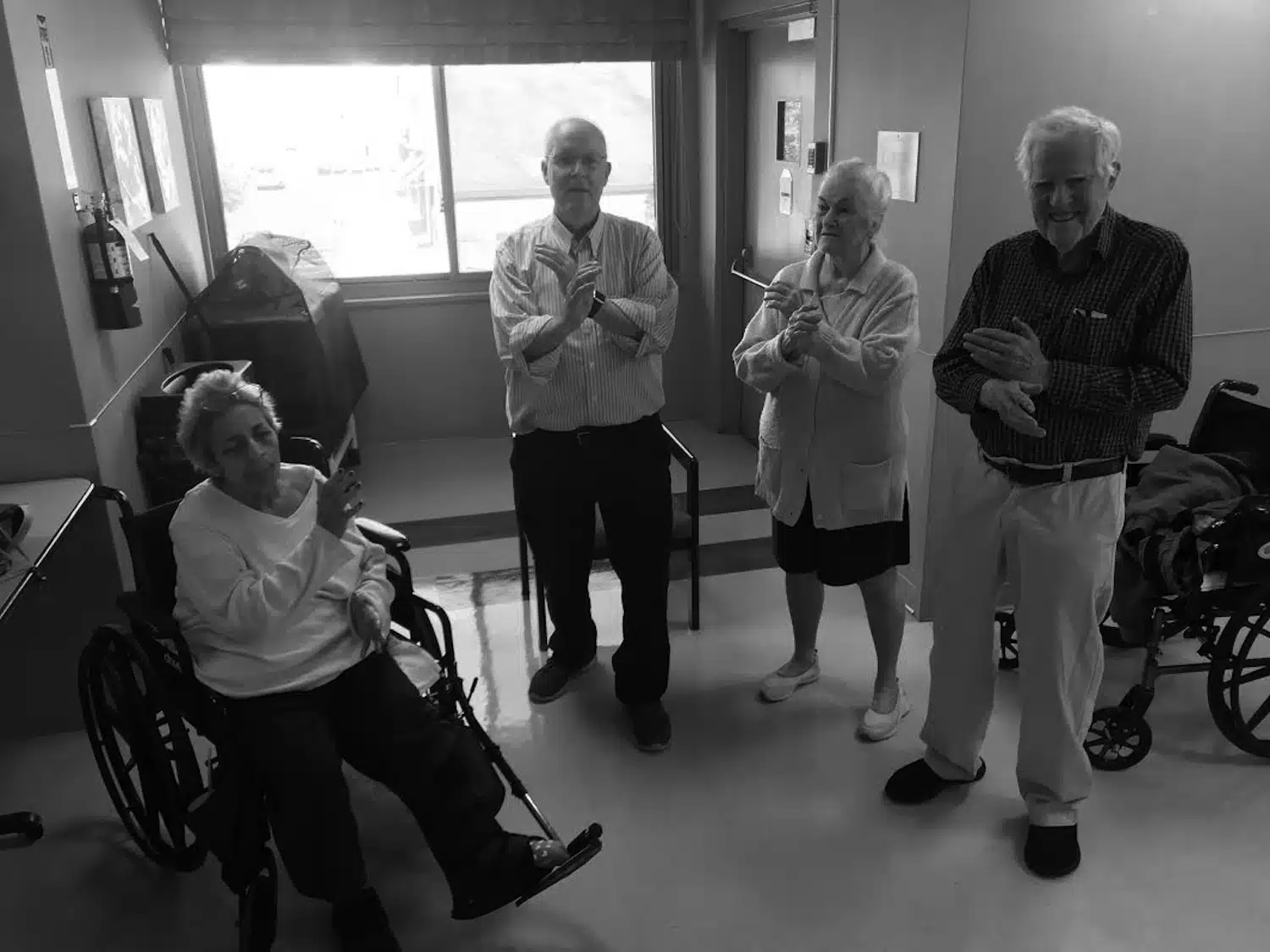
Two years ago my neighbor Jerry, now 99 years old, had to move out of the senior residence apartment building where we both lived to a long-term care facility nearby. Since then I have been going once weekly to teach and practice with him at his new home.
Two other residents have recently joined us. Jackie, 86 and blind, can only see dark shadows. A few months ago she invited her new roommate, Marie, who is recovering from a stroke and is also blind. I’m 70 and the youngest in our group.
Here are some things I emphasize, usually through repetition, when teaching TCC to “my elders.”
Keep the form.
I’m talking mostly to myself here. Jerry does the entire practice standing, yet his shoulders hurt, and he can’t lift his arms much higher than his stomach. Jackie focuses more on arms and wrists and likes bigger movements, which she can sense better. Marie does all the movements right now from only one side of her body. I can see micro-movements in her frozen left hand and foot.
Because I’ve learned by necessity to accept a lot of variation, I’ve learned to remind myself each week that my own form needs to be as consistent as possible. I see this mirrored back in Marie’s weight shifts while sitting in her wheelchair; Jackie’s wonderfully soft wrists and yinning and yanging when standing; and Jerry’s adaptation when working with a painful shoulders.
Always return to weight shifts.
I think of moving from the tan t’ien. I use many of the metaphors learned from my teachers such as: feeling the sand filling one leg like an hourglass while the other leg gets light. I say this during every movement. We spend time feeling both legs rooted to the ground. All three students have experienced a vast improvement in their balance, and their physical therapists have noticed this.
Delight in sudden and amazing sensations.
I wonder as we age if we are more likely to feel the Chi through warmth and tingling, or fluttering fingers? Is it because we’re less distracted? Or are nerve endings more exposed? Each of my three students reported from their very first lesson that they could feel sensations in their fingertips and other pleasurable sensations. For some movements we work physically closer together, and everyone expresses a strong sensation of the flowing Chi. It’s not uncommon for someone to let out a “Whoop!” during the practice.
TCC really can be done anywhere.
I’m not an official volunteer, but over the last two years the staff know me as the “T’ai Chi guy,” and simply allow me to find whatever space is available on the Sundays that I go into the nursing home. The four of us sometimes practice TCC with every television set in every room blaring into the hallways. We commandeer space in one of two lounges, in the reception area (where sometimes the receptionist joins in, sitting behind her desk); in a corner of a dining room; and in summer, in the small courtyard outside; even in someone’s room when they are bedridden.
Pay attention to back-up chairs and remind everyone to hydrate.
We do a 45-minute practice. Jerry and Jackie stand. Since the beginning I’ve always put a chair behind them, or put them in front of a couch in case they lose their balance, but no one ever has. (Marie practices from her wheelchair.)
One time Jerry got suddenly and unaccountably tired. I asked him if he’d had any water recently. He couldn’t remember and when I brought him water, he came back to life within ten minutes.
We do TCC no matter what.
Marie has clearly benefitted from the practice even with paralysis on one side. Jackie has had pneumonia, and when she got out of the hospital, and it was safe for us to visit in her room, we all did TCC around her bed. I suggested that she could just listen as I talked through our movements.
Debrief and let the sun shine in.
This is the only group I’ve been in where everyone wants to talk afterward about the wonderful sensations they feel: warm hands, tingling fingertips, a wave of pleasant heaviness across the shoulders, a paralyzed hand starting to lift and more.
Early on one of us was constipated from a new medication. I said, “TCC is reputedly great for regularity. You may be pleasantly surprised soon.” Someone reported during the next class that within an hour of the previous class, the problem was solved, and there’s been no problem since.
Jerry has become increasingly hard of hearing, and I arrived one day to discover him sitting in the courtyard with four family members who had traveled a great distance to visit. Because of his hearing everyone was mostly silent. I invited them to join our practice, and they eagerly did. This gave them a wonderful way to spend time with Jerry without having communication challenges. There were lots of smiles.
I’ll never forget how inspiring it was when Jackie did the whole practice flat on her back in bed. At one point I’d looked over at her and she was doing the arm and wrist movements, while wearing an oxygen mask. Her legs kept releasing energy and we couldn’t stop laughing as her feet continued to dance under the sheets, all on their own. What joy!
Topics: Adapting the Practice, Aging, Chi and Intrinsic Energy, Memory Care, New Jersey, Seated T'ai Chi Chih, Weight Shift
Originally appeared in: November 2019