
Categories: Conference Presentations & Reflections
The Brain On TCC
Neuroscience, Neuroplasticity, Meditation and Moving Meditation
Dr. David Parrish, Media, Pennsylvania
Over the last decade, scientific research has clearly determined that the brain changes consistently over the entire lifetime. Prior to this new evidence based on brain imaging technology, it was believed that after early adulthood the brain did not continue to change or develop. This discovery is revolutionary in many ways. It means that we can change how our brains function and the quality of our life.
According to leading scientists, development depends on whether we practice the specific ways of experiencing and behaving that change the existing neuro patterns in a desired direction. Dr. Richard Davidson, a leading brain scientist, has asserted that given that we now know that we can take responsibility for our minds and brains in terms of actively engaging in practices that change the brain in positive ways, we can intentionally produce a state of well-being (see “The World We Make” on YouTube, March 10, 2016). He further stated that, “we can see in our research the influence of certain kinds of meditative practices on the cultivation of key skills that are essential aspects of well-being.”
Research has shown that meditation practices that involve the practice of attention, resilience, positive outlook, and generosity have a significant influence on the structure and functioning of the brain. Based on this research, Davidson concludes that if we practice specific forms of meditation that change the brain and produce an experience of well-being, then well-being is a skill that can be acquired.
The implication of this revolution in brain research and specifically the finding that certain meditative practices have significant influence on changing neuropatterns, is that the practice of T’ai Chi Chih, as a powerful form of active meditation, can change the brain and produce a state of well-being. Therefore, when we practice TCC, we are practicing specific aspects of well-being.
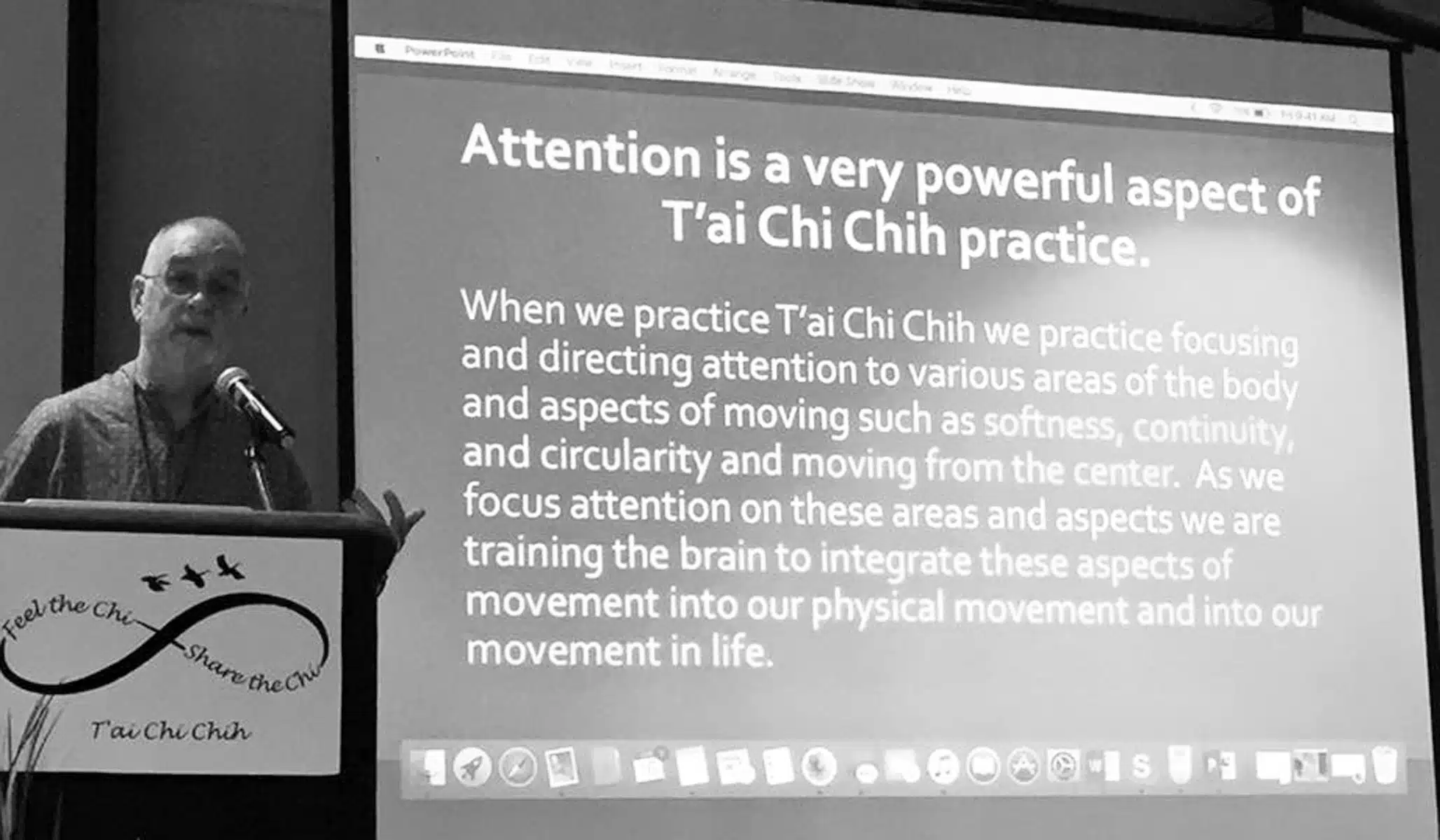
In TCC we practice focusing and directing attention to various areas of the body and aspects of moving, such as softness, continuity, circularity, and moving from the center. As we focus attention on these areas and aspects, we are training the brain to integrate these aspects of movement into our physical movement and into our movement in life.
Resilience is another powerful aspect of our practice of TCC. When we practice “letting go,” letting go of tension, letting go of the past and future, and letting go of thinking, we are practicing resilience. This practice trains our brain to let go of negativity and let go of the past, and thus recover more quickly from the adversities of life.
Positive outlook and generosity are qualities that arise out of the practice of TCC, and thus further train the brain to integrate aspects of well-being.
The practice of TCC constitutes a practice of well-being. This means that TCC is an evidenced based mindfulness practice that changes the mind and brain and produces an experience of well-being.
The fact that TCC is an evidence based mindfulness practice means that based on current science, TCC is a practice that can have a significant positive impact on brain development. It is especially valuable for teens to learn TCC given the fact that this practice enhances the brain for learning and helps reduce anxiety. With this scientific base, it is a potentially important practice to introduce in a curriculum of basic life education in schools.

Topics: Conferences and Retreats, Letting Go, Meditation, Research and Studies, Schools and Children
Originally appeared in: August 2017