
Categories: Student Experiences & Reflections
The Road To The Mountaintop
By: Larry Bloom
Sandy Springs, Georgia
At times during my morning T’ai Chi Chih practice, thoughts fade away and images of the movements flash fleetingly through my mind. They rapidly retreat and are replaced with a feeling of wellbeing. Sometimes I wonder, “Am I being stimulated in some mysterious manner to create pictures of the TCC movements? Or, is it just the latent effect of reading too many Dr. Seuss books as a child emerging from my subconscious.” I don’t know, but motivated by my son’s gift of a digital drawing tablet and painting software I began thinking about the project, letting it unfold on its own. Here’s the story behind the image, “Daughter on the Mountaintop.”
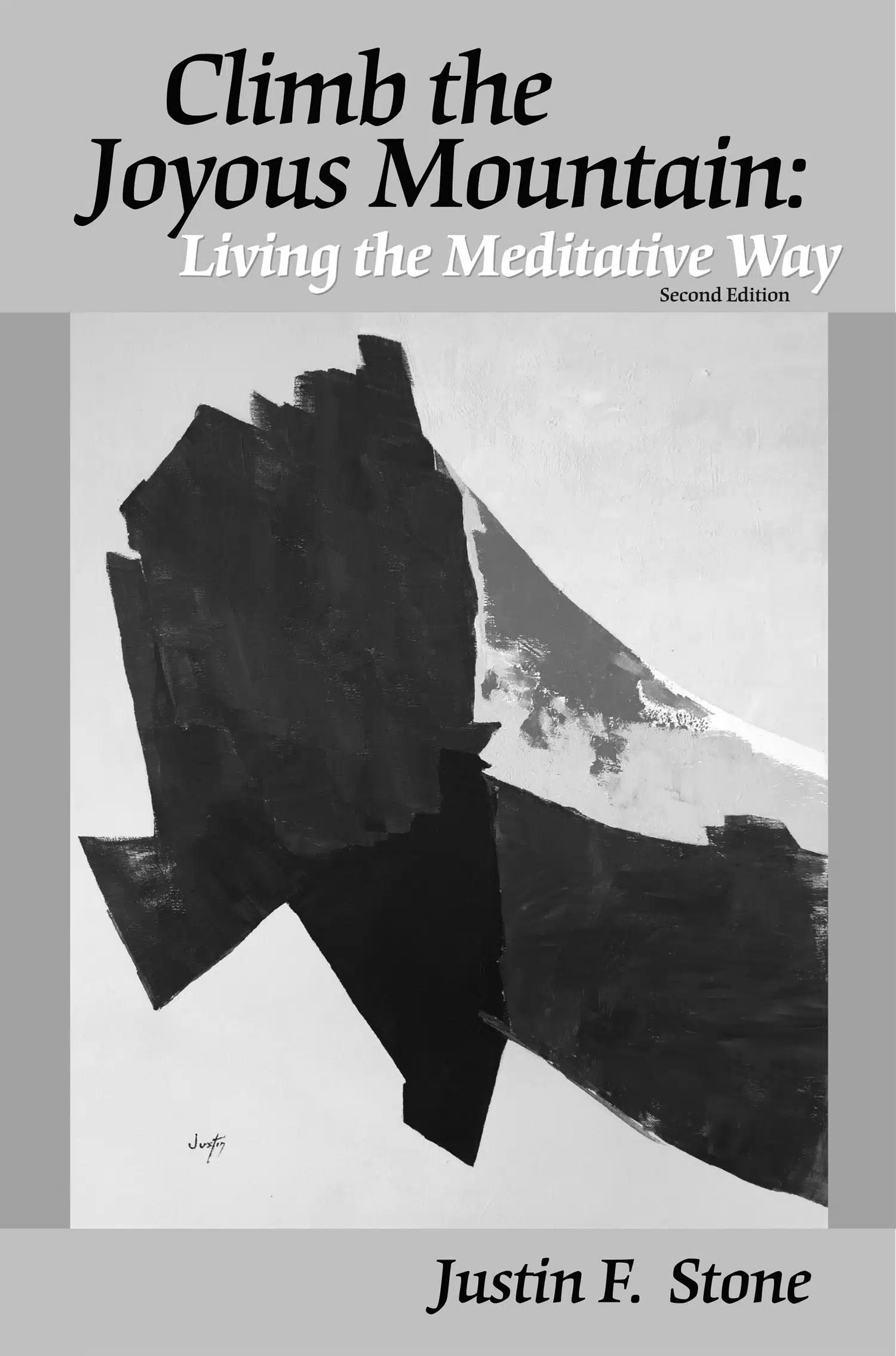
Early on I found myself reflecting on the art that Justin included in his books. Some originated from Justin himself. On other occasions he chose to include that of friends such as Ou Mie Shu. In Climb the Joyous Mountain, Justin remarked, “There is a quality about my friend Ou Mie Shu’s drawings, and the captions with which he inscribes them, that I can only describe as simple humanity… Because his work so represents the quality we would like for this book, these drawings are included with the hopes that the reader will enjoy them as much as I do.”
Finding inspiration, I sought to understand some of the art forms that might have contributed and particularly appreciated learning about the following:
Shodo
Shodo or the art of Japanese brush calligraphy has its origins in China 3000 years ago and is an ancient art separate from any other creative work. It differs in that its main focuses are simplicity and a mind-body connection. It is achieved by applying the elements of art, specifically line, shape and space. Often the line is drawn with a specific focus such as love, determination, or positivity. These feelings can often dictate the type of line that follows (e.g., whether it is wavy, straight, grainy or curved.) Shape is an important aspect and is achieved with dragging, pressing, and sweeping techniques. No outlining is ever used.
Zen Calligraphy
Here the attitude is that true creation arises from mu-shin, the state of “no mind,” in which thought, emotions, and expectations do not matter. Truly skillful Zen calligraphy is not the product of intense “practice”; rather, it is best achieved as the product of the “no-mind” state, a high level of spirituality. One must free his or her mind and heart of disturbances and focus only on the meaning of the character. Becoming one with what you create, essentially, is the philosophy behind Zen Calligraphy.
Enso
In Zen Buddhism, an enso is a circle that is hand-drawn in one or two uninhibited expressive brushstrokes to express a moment when the mind is free to let the body create. It symbolizes absolute enlightenment, strength, elegance, the universe, and mu (the void). It is characterized by a minimalism that exemplifies the various dimensions of the Japanese wabi-sabi perspective and aesthetic: fukinsei (asymmetry, irregularity), kanso (simplicity), koko (basic; weathered), shizen (without pretense; natural), yugen (subtly profound grace), datsuzoku (freedom), and seijaku (tranquility).
In Climb the Joyous Mountain, Justin articulates his appreciation of the wabi-sabi aesthetic: “To understand Japanese people, one must know something of the wabi–sabi concept. The Japanese sense of beauty… usually relies on delicate understatement. What is left out is just as important as what is put in.”
It is easy to appreciate the connection between these artistic philosophies and TCC. Respectfully, I have no pretense that one can just causally jump in and do them justice. However, the principles of these styles can serve as inspiration for anyone at any level. Allowing myself to be inspired but not intimidated, I thought about possible guidelines that would honor TCC: 1) Keep it simple, using as few strokes as possible to create the image with no effort; 2) Express yin and yang through the free flow of lines, shapes, texture and space, and 3) Paint from a place of love for TCC encouraging the image to be personal and the artist to be non-judgmental.
Following my newly created guidelines took longer than I fully appreciated at the beginning. The “Daughter on the Mountaintop” image was created in about a minute and contains only five strokes. Ahhhhh – no effort! But to get prepared required testing several hundred combinations of digital brush styles and textures, and experimenting with the effects of pressure on the brush to achieve a yin/yang of changing granularity, line thickness and density. I found if I was mentally preoccupied, the lines just did not flow. I had to find that place where thinking did not inhibit the course of the brush.
The journey was joyful and a reminder of the effort of no effort. Imaginably others could be encouraged to reflect on TCC movements and put their brush to paper. Perhaps we could collectively create a set of images to represent the movements.
Topics: Climb the Joyous Mountain, Daughter on the Mountaintop, Georgia, Personal Stories, Softness and Continuity, Yin and Yang, Zen and Buddhism
Originally appeared in: May 2014