
Teaching T’ai Chi To Veterans Improves My TCC Teaching
One night last August, I “hung out” virtually for about 90 minutes with David-Dorian Ross (“DDR”), several T’ai Chi Chih instructors and all the Taijifit instructors who are also participating in the new FreeT’ai Chi for Veterans program. We discussed a billion roadblocks large and small that all of us had been encountering. At first I felt disheartened that things weren’t going exactly as anyone (including DDR) had initially hoped. (In fact, if you spend any time on the Taijifit Instructor’s Share Facebook page—TaijiFit’s version of our TCC Teacher’s Circle—you’ll quickly see that most of DDR’s own TaijiFit instructors are just as confused as many of us are.) A few minutes into the meeting, however, I noticed the situation was bonding us in ways I never expected.
Toward the end of the meeting DDR gave a brief lesson on how best to teach Veterans based on a governing principle of his style of T’ai Chi called Fang Song (pronounced fung soong). DDR explained that both words essentially mean relax, but he also reminded us that Chinese characters are often illustrations as well. The word Song looks like a Master pulling the pin from his topknot in order to let down his hair. Being a big-haired girl myself (who also wears it pulled up most of the time), I got a perfect sense of Fang Song (and thought “isn’t this a way of describing some of our own movement principles?”).
That night DDR also suggested I connect with Marcus Carbo to learn more about Veteran’s Administration politics and the vibe of my local Wilmington VAMC. (Marcus was a T’aijifit instructor and Army Vet, and before this new federal program was launched he’d been volunteering to teach T’ai Chi inside the Philly VA Medical Center. DDR had recently hired him as Taijifit’s official liaison to the VA.) I followed up and—just like April, Sandy, Pam, Dan, and all my wonderful TCC mentors—Marcus has been a constant support, never failing to notice whenever I’m attempting to push the river (a habit energy that almost always shows up whenever I’m faced with a challenging project).
What are my takeaways from working with the Tai Chi for Veterans program?
• Somewhere I became judgmental about TCC versus other T’ai Chi practices (completely unintentionally, of course). Perhaps in my efforts to explain the distinctions between TCC and other practices I also unconsciously began thinking of TCC as good and other practices as bad? During the last few months, however, I’ve noticed an entirely different possibility: perhaps all the T’ai Chi practices are more like one language with hundreds of dialects.
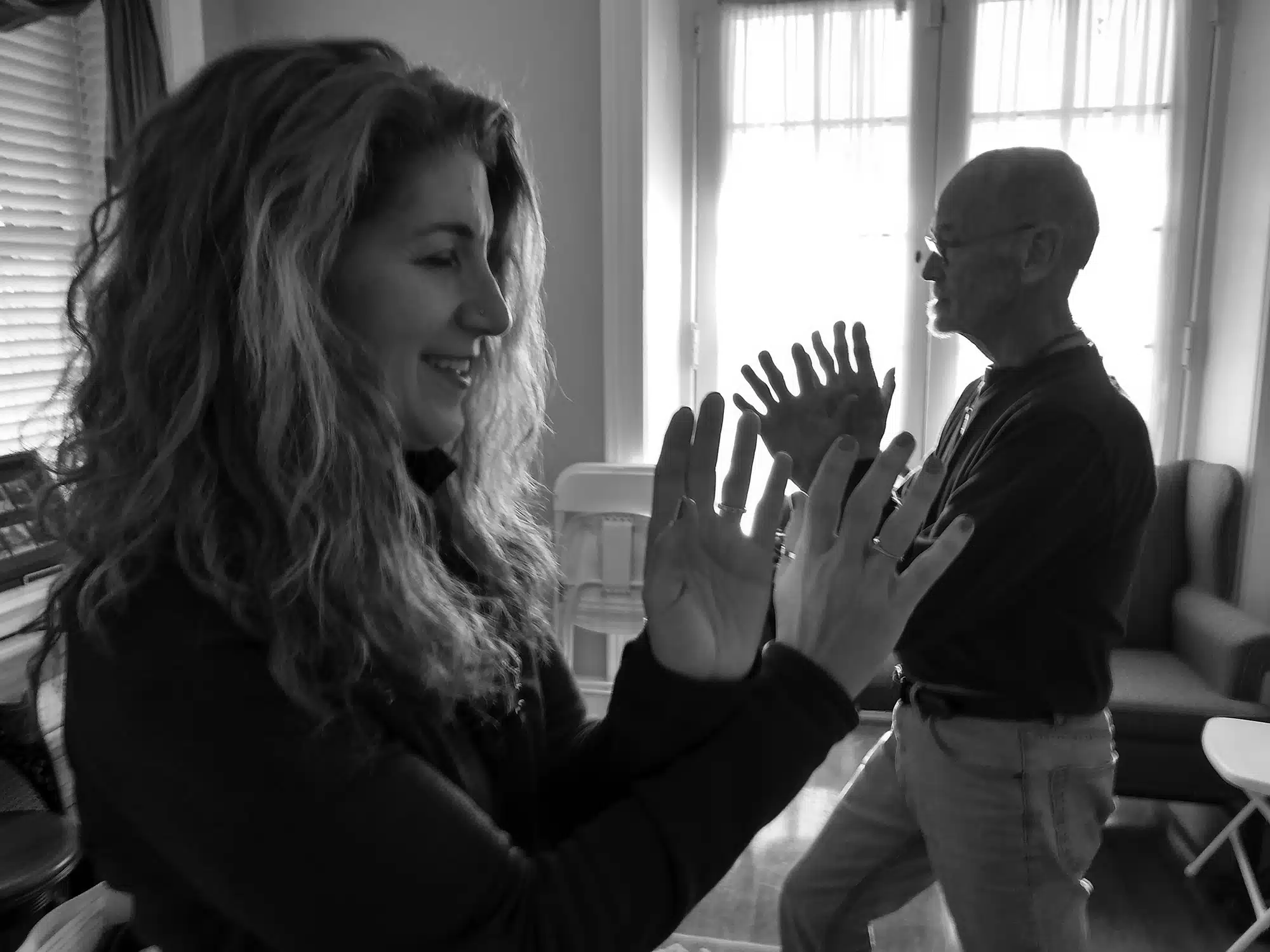
• I’m excited and surprised at how meeting and working with so many Vets is informing the way I teach TCC. In order to not trigger the students in my first class, for instance, I followed DDR’s advice to use few-if-any words while moving as much as possible. And I was delighted to notice everyone flowing just as smoothly and easily as any other group of TCC newbies. (On the second class I checked in with how the returning students felt after their first experience then asked if they’d enjoy a bit more information.)
• The students were interested in learning more, so on week two I taught the same way I teach any other TCC class. Although this program is only a few months old, perhaps the borders between various T’ai Chi teaching styles are already beginning to blur?
To quote Judy Chancey, this program seems more like the embodiment of a long slow weight shift than anything else. Shouldn’t we, of all people, be able to patiently embrace the beautiful unfolding of what could potentially evolve into an entirely new approach to public health?
The Taijifit onboarding process is still a beast, but if you haven’t already signed up I encourage you to at least think about it. Pam, Sandy and Dan have all told me on numerous occasions how Justin dreamed that something would eventually launch TCC into the spotlight. IMHO this new program might be the vehicle.
Topics: