
Categories: Teacher Experiences & Reflections
Supportive Cohesiveness
I confess. I’ve never been good at regular practice on my own. I do enjoy T’ai Chi Chih (TCC) on my own, and practice fairly regularly, but not at a consistent time or place; not steadfastly. I’ve noticed anything that I am “supposed to” do becomes difficult to find regularity and consistency. Many things are in this category, from my chronic health issues to PT exercises and nutrition.
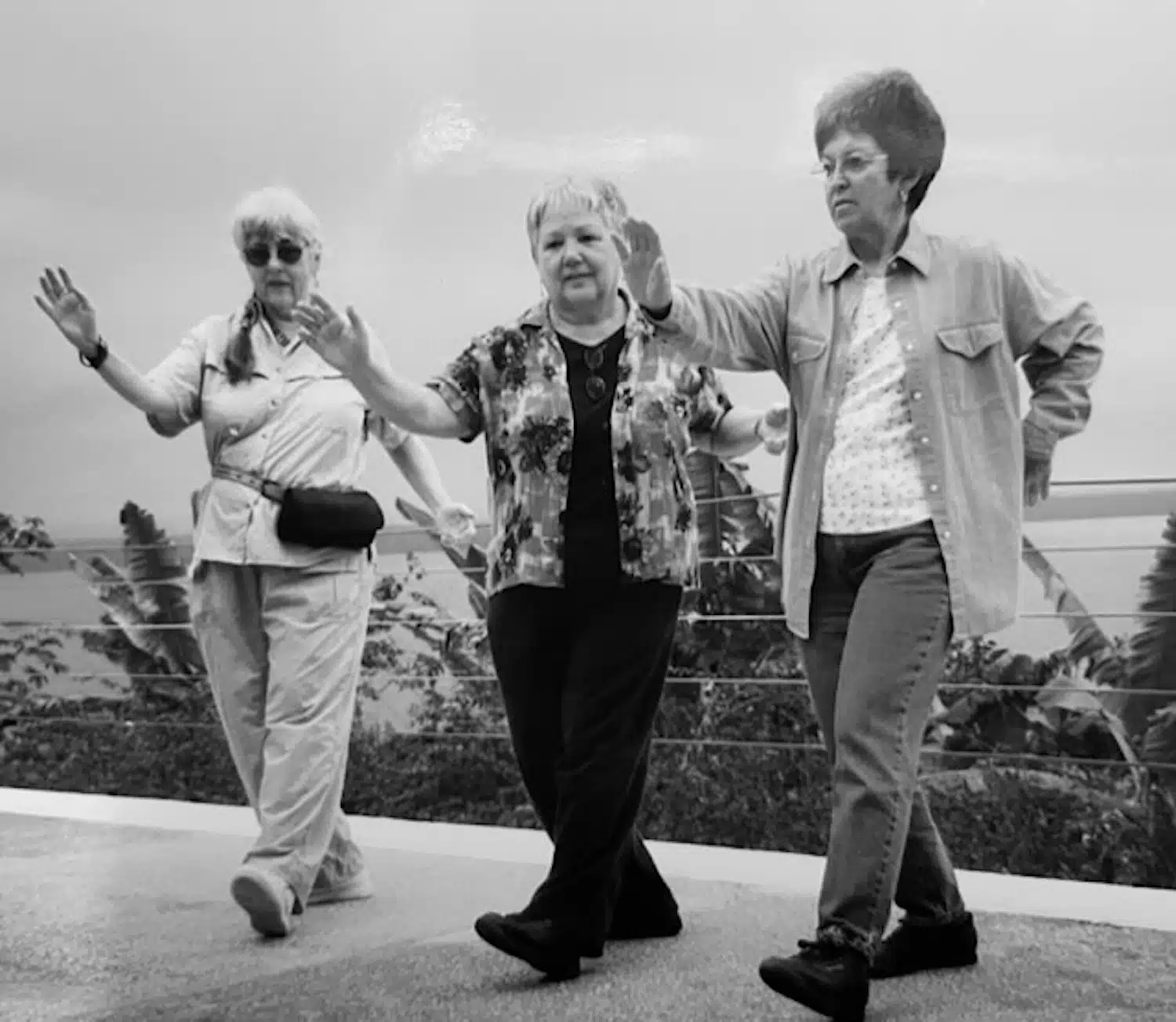
I attend Zoom group TCC practices and classes, and I teach. Even on Zoom, the group increases my energy flow. I love silent group practices and those that allow exploration and deepening into TCC.
Some teachers point out that TCC is an inner discipline. I agree, but I don’t see group practice as inconsistent with that. What makes a big difference for me is whether I’m practicing or working on the practice. Both are valuable but working on TCC (reading the menu) must be balanced with lots of moving meditation (tasting the food). Like all aspects of consciousness, it’s a subtle and often tricky difference to feel, especially while teaching.
One of the wonderful effects I get from TCC is balancing the nervous system out of the activated, anxious, and sympathetic state. But it’s a Catch-22 because it’s trickier to get myself to practice when I most need it. My body is not always up to the (other) demands I put on it. Instead of slowing down my life, I let myself get distracted from practice. I’ve learned that I can’t put expectations on my practice — practice helps me when I use it, but it’s not its job to fix me.
In Bird by Bird, Anne Lamott explains that one of the hardest parts (of writing) is to “keep your butt in the chair.” She uses humor to show the shoulds the mind will drag up to try to distract us. Practicing with a group keeps me on track, and the energy transfer shows me new awarenesses that I don’t find as easily on my own. When teaching, I remind students of what I myself need awareness of, since often we reflect each other. I feel a zing when something resonates with the group, and yet the learning is still internal.
In a recent group Seijaku class, after the Jing, Carmen reminded us that there is always something to discover or learn from each movement. She asked us what we had just learned or felt regarding the idea of connection. For me, connection felt like a sense of stability, of cohesiveness without effort. “Supportive cohesiveness,” I concluded. “It’s not tense but everything is pulling into itself while still in the flow.” It was valuable to put words to the feeling, even for just that moment while the feeling was amplified by the group, which is an important part of that grounded support and connection.
That said, it’s all about balance. There is something magical about diving into these movements and exploring the wilds of the energy sea alone, with no constraints from others — of surrendering and letting go, with awareness, a call home that would be unwise to ignore.
Topics: Chi and Intrinsic Energy, Colorado, Daily Practice, Group Practice, Letting Go, Personal Stories, Seijaku
Originally appeared in: August 2022