
Categories: Where in the World
Teachers Supporting Teachers: Self-directed Continuing Education
By: Lisa M. Otero
Oxnard, California
At every teacher conference I have attended in the past five years, I have overheard at least one (and sometimes several) teachers say, “We should have a continuing education requirement” or “Why don’t we have a continuing education requirement?”
The fact is, we don’t have a formal requirement to continue our education. We don’t because Justin Stone was against any such requirement (and also against the bureaucracies that would be needed to mandate and enforce such requirements).
It is an honor and a privilege to be entrusted to teach T’ai Chi Chih. Justin expected that all accredited TCC teachers would take their responsibilities seriously. Justin trusted in our teh (the power of our inner sincerity) as teachers and trusted that we would take initiative to continue to develop both our personal practice and our teaching skills.
So, each of us might ask ourselves: What have I done, since I was accredited, to maintain my personal standards as a teacher of this dynamic, evolutionary practice? Do I take classes taught by other teachers? Do I maintain a consistent personal practice? Do I attend workshops or retreats offered by experienced teachers? Do I attend intensives or audit teacher accreditation courses? With sincerity and humility, do I seek feedback from other teachers? Do I regularly review the TCC photo textbook, Justin’s advice pamphlet, “Teaching Tips for Teachers,” and Justin’s books and printed lectures? Do I subscribe to The Vital Force journal (VFJ) and reflect on the experiences of other teachers and serious students? Do I share my own experiences with the larger community by writing for the VFJ and posting on social media forums, like Facebook? There are many, many ways and means of keeping our practice and teaching refreshed and thriving.
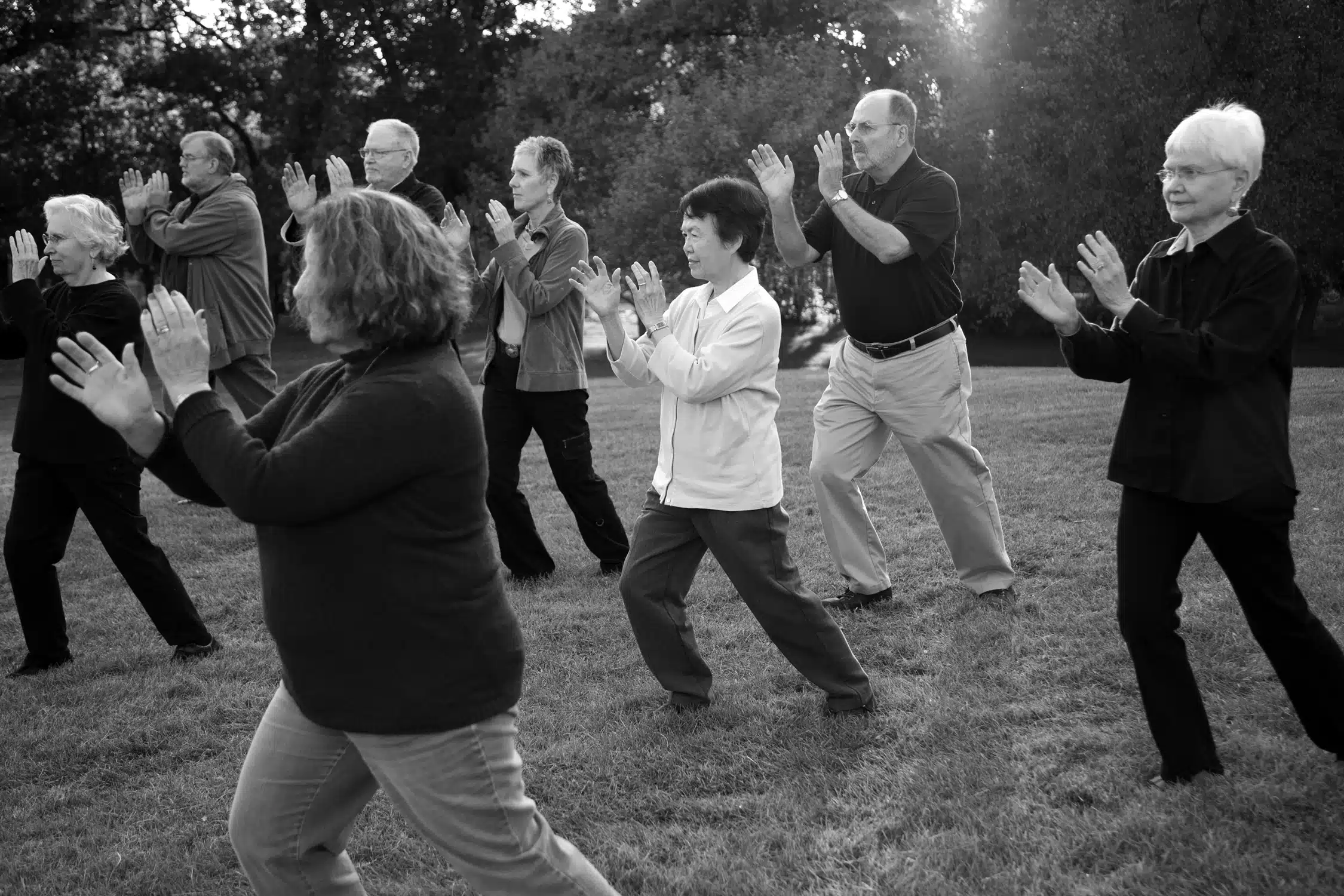
Here’s another. In my local community we are blessed with seven active, accredited teachers. We substitute for each other, lead special practices together and take each others’ classes. For the past year or so, we have gotten together once every three months for a social evening, where we have a silent practice, share a potluck meal, catch up on how our classes are going and support each other regarding teaching achievements and challenges. We think of this as our quarterly mini-retreat (which we very much enjoy since we are all very fine cooks). Recently, we decided that, in addition to our quarterly social evenings, we would meet once a month, for a two-hour session to have a silent practice followed by a one-hour presentation or facilitated discussion to enrich our continuing education.
Each of us agreed to facilitate a session. We have had three so far. The first was lead by a teacher who is also a retired acupuncturist, well-versed in Chinese medicine. She gave an intriguing presentation on the significance and power of healing sounds in Chinese medicine. At the next session, two teachers shared their experiences attending two separate retreats led by Sandy McAlister. At the next session, three teachers who attended Carmen Brocklehurst’s annual “Learn Seijaku” retreat in Albuquerque, shared their experiences of it. At our next session, we will continue our Seijaku studies, watching Justin’s Seijaku dvd together and doing a group practice.
We will also share our experiences of the Chi: what the circulation of the Chi feels like for each of us, and how we discuss it with students. For a future session I have volunteered to lead, I am asking everyone to review Justin’s collected short essays in Spiritual Odyssey and to be prepared to discuss whether and how we present TCC to beginners as a physical practice or a spiritual practice or both. I am hoping that our presentations and discussions will evolve into VFJ articles and perhaps become topics for forums at future conferences and workshops.
Of course, you don’t need a group to continue your education, but this might inspire some of you to form informal TCC study groups, perhaps including serious students as well. If there are teachers in your area, reach out. Even if you are the lone teacher in your community, you can connect with others via the Internet or phone to provide each other support. The conference this summer in Seattle will be a great time to make connections that you can continue to grow throughout the year. We are all here to support one another – just as Justin encouraged and supported all of us.
Topics: California, Continuing Education, Group Practice, Justin Stone's Teachings, Seijaku, Spiritual Odyssey
Originally appeared in: May 2016