
Categories: Where in the World
Growing Local T’ai Chi Chih Communities
By: Deb Bertelsen
Maplewood, Minnesota
Growing a local T’ai Chi Chih community requires a positive intent, focus, effort, commitment and lots of teh (inner sincerity). There isn’t a template for how it should be done. It takes time and occurs in stages. One teacher works to grow the interest in TCC and get other teachers accredited. Next, these individuals expand the class offerings and exposure in different venues, creating a TCC extended family, which, through its own evolution, continues the outward circular growth. When you have a number of accredited teachers across a large geographic area you reach the next stage of development: figuring out how to work together and support each other.
With long-established relationships, the Dakotas, Iowa and Wisconsin are part of the Minnesota family. Our community is graced with longevity and a shared vision to strengthen who and what we are – locally, nationally and internationally. Over the course of 20-plus years we have grown from 1 to over 60 accredited teachers.
The compassion and dedication of our teachers make our community special. The “why” of what we do is often tied to a desire to give back and to honor those who have walked the path before us. Of course you run the risk of a few people doing most of the work – unless you invite more people to the table and truly believe your community has untapped skills and talents. Invite people to participate in unexpected ways … students and teachers alike. For example, our website is handled by two teachers with varied backgrounds, located in different cities; updates are done by a teacher’s grandson. Cool isn’t it? The website communicates upcoming events, lists teachers and class locations, and provides a link to the greater community via taichichih.org.
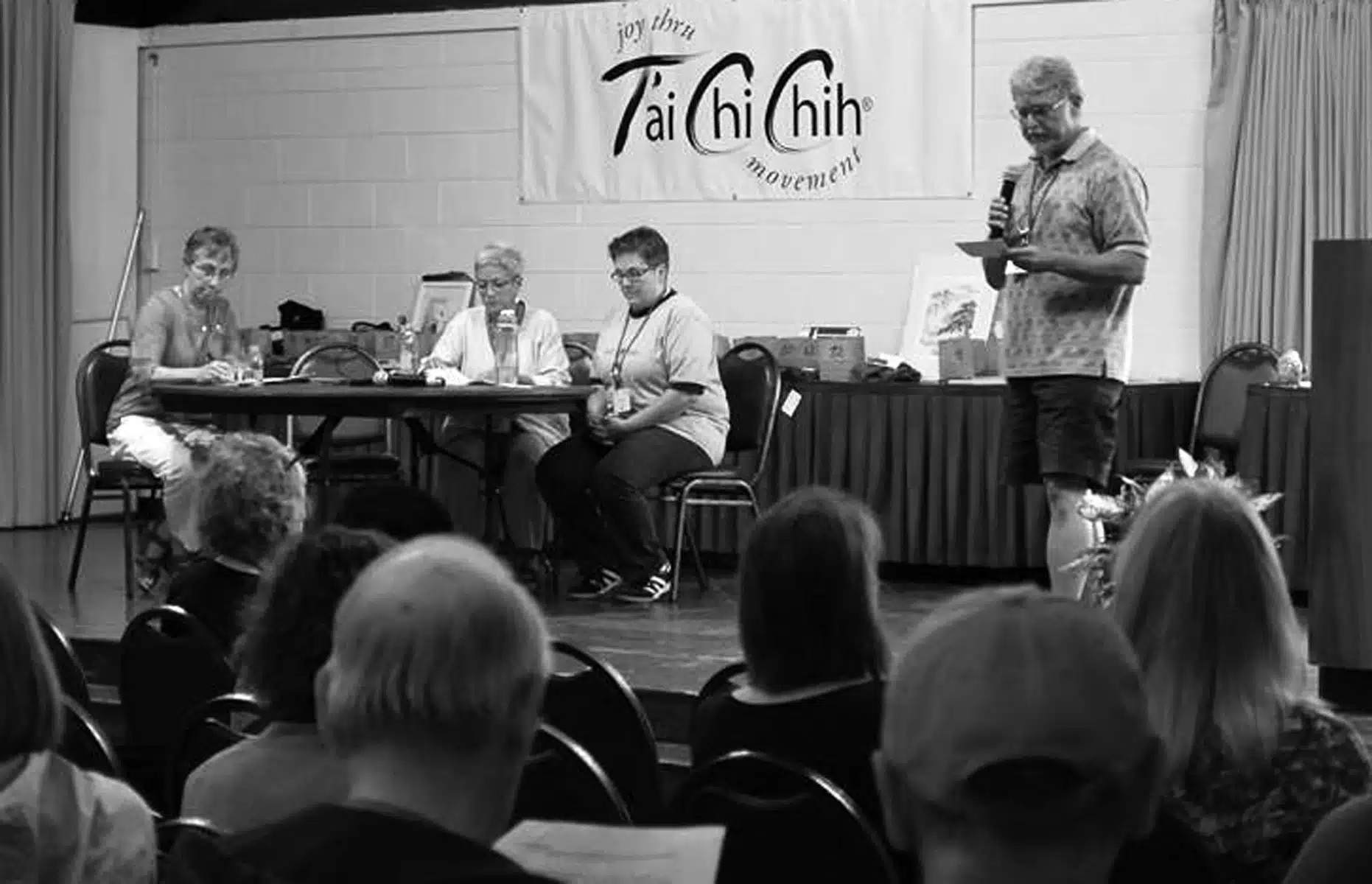
Our quarterly gatherings, open to all, are for connecting and sharing. We share Justin’s words, focus on a movement or two, enjoy a practice, and bring a potluck dish to share. Afterwards, for those who wish to stay, we talk about TCC business. To encourage people to attend, we alternate meeting days and times.
For efficient communication, one individual maintains a community email database of accredited teachers and forwards information out to the entire group. Another person handles updates and postings to our Facebook page.
In order to rekindle the TCC connection we initiated a “We Want You Back” campaign. We want to re-establish the bonds we felt so deeply through our accreditation journey. People who knew people volunteered to connect with community members in person, by phone or email with an invitation to attend a future gathering.
Support for one another. A Teacher Development project currently underway will survey our members on two fronts. First, identify who is teaching, to what extent, and whether they want more teaching opportunities, are interested in serving as a substitute, or are looking to cut back. The focus is to match people with possibilities. Second, identify teaching opportunities (market niches) and share that information. Who is asking for classes that we are not aware of? Where are we missing out?
Mentoring and Training. We are passionate about mentoring students and teacher candidates in a consistent manner. We designed an “Accreditation Journey Framework” in 2011 and presented it at the 2013 teacher conference. We put together Movement Workshops for students, showcasing local talent through participation from teachers in the area. After accreditation, we continue the mentorship for six months, pairing newly accredited teachers with seasoned teachers.
Working outside of Minnesota. Interstate cross-pollination paired Judy George and Marie Dotts, who used to live in Minnesota, and now is growing a vibrant local TCC community in Northern Colorado. Judy visits Colorado quarterly and will likely be the second signature teacher for Marie’s candidates for accreditation. Everyone loves the experience. Rumor has it these compassionate and deeply committed teachers are developing a “Teacher Candidate Referral Checklist” that delineates four important sections: Knowing the Movements; Knowing How to Move; Familiarity with the Principles; Inner Sincerity.
Positive intent and teh are essential guiding principles to educate and teach people about TCC, as well as to build a community. Don’t re-invent the wheel – use what others have done as a resource. One size doesn’t fit all, so try different strategies, capitalize on what works, massage what doesn’t and abandon whatever stands in the way of progress. If something didn’t work before, look at it from a new perspective. The Vital Force provides a perfect forum to share what works, what doesn’t and challenges. Minnesota is still evolving. We want to know what is working elsewhere to add to our toolbox.
Remember, there is a tremendous amount of ability, knowledge, talent and skill around the TCC globe. Tap into that creative energy. You may be surprised what you find – the hidden gems, the gifts of TCC.
By Deanna Rasch, Richmond, Virginia
Mostly because I really needed some folks to practice with – a local community of more than one.
That’s my best answer as to why I worked so hard in the past two and a half years to help grow a TCC community in the metro Richmond, Virginia area (known locally as RVA).
Not that it hasn’t had its challenges. But, then, I’ve been known to be persistent. At the doors I’ve knocked on, I have heard everything from “[insert population] doesn’t do T’ai Chi; that’s why we don’t have it,” to “we’re really all about yoga here,” to “kids will be bored with that,” to “that’s (eye roll) really T’ai Chi ‘light’.” Some folks weren’t always that polite.
I kept in mind some sound advice from Dan Pienciak, “Go where you know.” Ultimately, that’s what got the ball rolling. Slowly at first, but, then, with more momentum than one teacher can handle. I started a local Facebook group (T’ai Chi Chih RVA); found space (at the yoga studio where I took an occasional class) that agreed to a one-shot workshop; invited friends to invite friends; and introduced the first 25 people who signed up to our practice. Since I didn’t have space to offer follow-up classes as yet, I followed up with interested participants by offering a weekly practice in a local park while I searched for a facility. This free practice continued to support students from the classes and serve those in financial need.
By “going where I knew,” I found a partnership with the Gay Community Center of Richmond (now Diversity Richmond) and a home for the first ongoing class, open to the LGBTQ community and allies. While we still take the class outdoors to a park to enjoy the summer weather, the class has been a consistent presence ever since. This also resulted in an invitation to do an LGBTQ Healthy Aging class. A formerly-naysaying parks and recreation director visited this class and agreed that, perhaps [insert population] might, indeed, participate in TCC, if offered at their facility. This class turned into the largest ongoing group. Eventually another weekly class had to be added to accommodate the demand for more practice opportunities. Those were marketed as senior classes, because, of course, the practice was not active enough for children…
Until a friend and (now advanced) student arranged an invitation to teach TCC at her middle school for a day – where about 500 students were introduced to the practice during their PE classes that day. When word travelled to parks and recreation about this, I received an invitation to participate in their summer recreation programs, bringing an introduction to TCC to hundreds of children, pre-teens and teens at a dozen locations where they were “camping” (in Richmond, hiding in the air conditioning) during their summer break. If you haven’t tried teaching the younger crowd yet, well, there is nothing cuter than a tiny person in a pink tutu wearing sparkly tennis shoes showing you how it’s done. Be prepared for a lot of yawning, too, as they remember that relaxed feeling that comes without crashing on the couch.
More friends, co-workers, students… more invitations to a local library program, and a professional development series for faculty/staff… you get the idea. It’s all about connection, community and sharing the practice wherever and whenever the opportunity presents itself. Whether it’s locally, virtually (through social media and video calls) or by travelling to attend events and visit other TCC communities, it’s all good. Put your hand out and chances are good that someone will take it and then extend theirs. And so on. It makes me smile (in that way that makes your eyes disappear) to know there are TCC students in RVA now preparing, in their own time, to become teachers themselves.
By Sheila Leonard, Newfoundland, Canada
My initial vision of pioneering T’ai Chi Chih in Newfoundland was simple: to share the good news of TCC with anyone who would listen, whether interested or simply curious, and responding to opportunities and/or creating them.
In 2003 I became an accredited TCC teacher, always awed and grateful. Tucked away on an island in the North Atlantic far from other TCC teachers and events, I faced two key challenges: how would I get started in fostering a local TCC community, and how could we connect with the larger worldwide community?
I started in the small town where I lived. My community of one gradually expanded. Connections opened. Invitations appeared. Classes grew. The Chi was very busy. But I was still only one teacher. As time went on, I readily posed the question and sometimes students spontaneously and/or cautiously raised it: “Accreditation? Who? Me?”
Beginner and Beyond Beginner classes (and eventually Saturday Retreat Days) deepened students’ practice with and without thoughts of accreditation. New doors opened by seizing opportunities and embracing invitations for “Come and See” demos and presentations.
Because student travel to the U.S. is so costly, we invited Dan Pienciak to Newfoundland. The preparation and promotion required time and energy that proved well worth the investment. I sought ideas and tips from seasoned hosts; students were eager and willing to engage. Occasional scholarships helped offset students’ costs.
Our teacher trainers and the Guide were eager to come. Dan has been here nine times since 2007, most recently in July. Dan’s initial workshops stirred student’s interest in becoming teachers, and it led to our first intensive in 2008, followed by accreditation in 2009, which graduated six new Newfoundland teachers.
Dan’s visits broadened student exposure to other teachers and fostered a sense of belonging to the worldwide TCC community. Every time another from outside Newfoundland joined us, it enriched our local island experience. It also united our province-wide community, a major challenge with our expansive coastal geography.
It is still about fanning the flame, dreaming as we grow. With six teachers, we now ask, “How small is big enough for an intensive or accreditation, especially given geographical considerations?” A very real challenge I pose to our Foundation. Another is whether our Foundation could subsidize travel cost for trainers’ sessions beyond intensives and accreditations, especially in international and/or in more isolated contexts to help level the playing field financially (so that all have more equal access to trainers)? Intensives and accreditations would increase and be all the richer for it.
Being so far removed from so much because of distance and cost has added challenges. Our island culture means limited exposure to new modalities. For many people TCC is seen more as exercise rather than a life-long internal or spiritual discipline, so they stop coming to class when they feel, “I know it now.” The challenge becomes how to keep students coming back long enough to really experience it and get hooked? Another challenge is the busyness of lives today. With so many opportunities, people are eager to check them all out, more like shopping therapy for perennial browsers.
As we dream our way into a future yet unknown, we continue more of what we have been doing, allowing the Chi, that Divine Intelligent Energy that Justin speaks of, to lead the way. Ours is but to nurture the dream. Bread needs time to rise. Jelly needs time to set. Trusting the Chi will do the rest when we allow. The key is to allow “More Chi. Less me.”
Let us continue to encourage and inspire one another. Indeed my current TCC Prison Ministry was encouraged and inspired by other teachers who dared to dream and shared their story. It is very humbling to think our Newfoundland story might somehow encourage and inspire others among us. Thank you Justin, and all.

Topics: Building a Class, Conferences and Retreats, Group Practice, Minnesota, Teacher Accreditation, Teacher Training
Originally appeared in: November 2015