
Categories: Featured Article
The Many Gifts of Group Practice
It’s surprising that I love group T’ai Chi Chih practice so much. When I sought my accreditation more than twenty years ago, I never intended to teach. When I did start teaching, a few years after accreditation, it was because I wanted people to practice with. What a gift to realize that I would always be able to form a practice group wherever I went.
After years of teaching several classes a week, COVID-19 forced the suspension of in-person classes for more than a year. My year of practicing on my own was good though; I deepened my personal relationship with the practice. When I resumed teaching in the summer of 2021, I connected with fresh awareness and appreciation of old and new students. I began to experience again the many gifts of group practice.
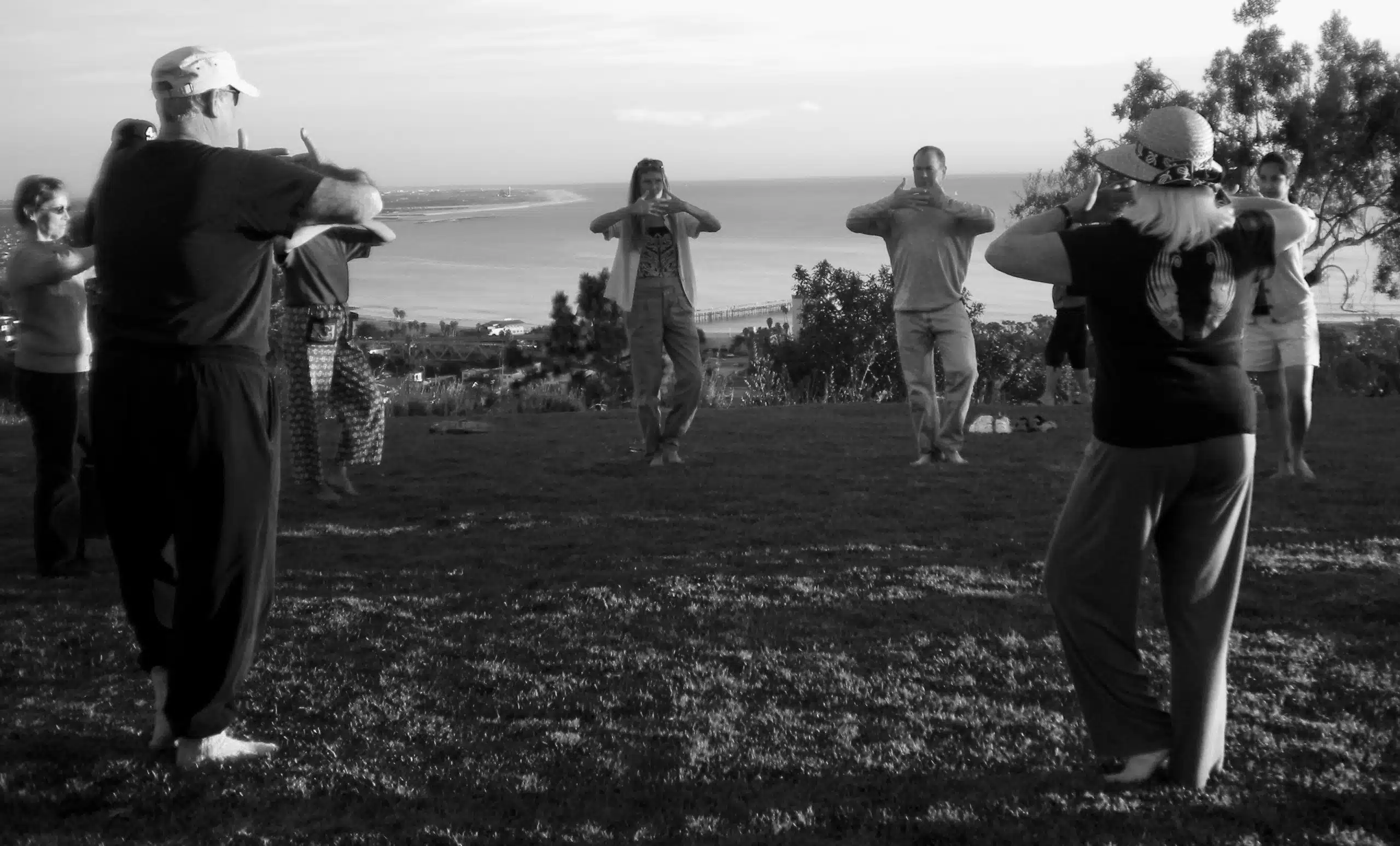
With TCC group practice we experience a connection and opportunity for human companionship that is rare. The fellow-feeling is not based on personality or on mutual affinities and opinions, or shared religious or cultural beliefs. It is not based on job or marital status or whether you have children or not.
What is the basis of this special connection? TCC teachers often marvel at how close they feel to their students. And students seem form a special bond with each other, though in truth we know very little about each other’s personal histories, likes and dislikes, or what we do for fun outside of class. We gather, exchange a smile or brief greeting, and settle into a groove, moving together in synchronicity, slowly, softly, silently, rhythmically. When else do we enjoy such lovely leisure with relative strangers?
We have all experienced that the soft, gentle, rhythmic movements of TCC are soothing to the mind, body, and spirit. I am convinced that engaging in tandem with others is soothing and enriching in ways that go beyond the myriad benefits of personal practice. In a world full of conflict, striving, and competition, we experience connection and dare I say love, without expectation or attachment. We give and receive impersonal love: human connection in a manner that is complete and completely fulfilling in and of itself. It leaves no obligation, no longing, no disappointment, no expectation in its wake.
This special connection does not happen automatically. I believe this optimal experience happens only if everyone in the session tries to truly sync up and practice at the same pace. Conversely, when everyone does their own thing and moves at their own pace, it can leave participants feeling jangled, disconnected, anxious, and sad. For this reason, I always stress the need for every participant in group practice to cultivate their inner awareness and a keen awareness of everything going on around them and the people moving with them. This is what it means to be fully grounded while engaging in group practice. If you practice with others and don’t attempt to sync up with them, you are missing an opportunity for a very special experience.
I often compare group practice sessions to classical music ensembles. The teacher or practice leader is the conductor, and the members of the class are the musicians. Can you imagine a concert with all the musicians doing their own thing, playing the same piece but at different tempos? You’d probably leave with a headache and an agitated disposition. Anyone who has had the pleasure of attending a concert where the musicians play with full awareness of one another and the conductor, knows what I am talking about. Why should TCC practice be any different?
Synchronicity and slow rhythmic flow are a tonic for what ails us in this demanding, fast-paced, hypercompetitive world. Group TCC practice provides an easily achievable method of experiencing peaceful, deep connection regularly.
Topics: California, Group Practice, Personal Stories, Running a Class, Softness and Continuity, Teacher Accreditation
Originally appeared in: November 2021